A Practical Guide to Whole-Home Audio
Plan zones, speaker locations, sources, control, and outdoor audio without compromising the architecture.
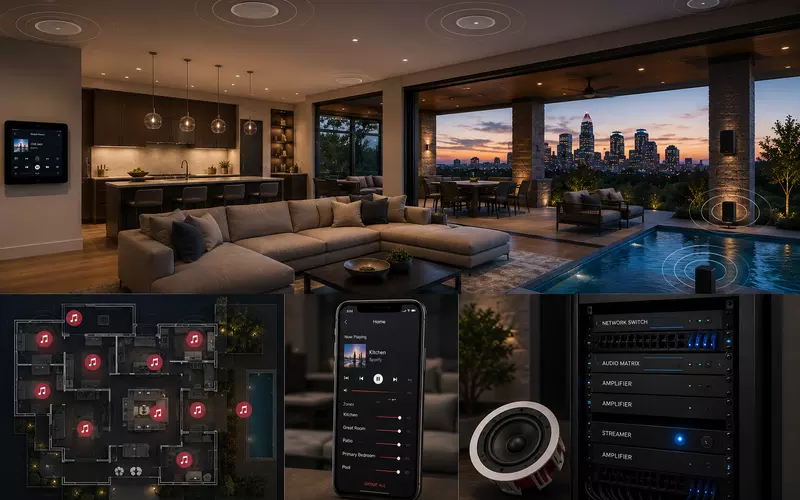
Music now follows daily life—from breakfast and remote work to evenings by the pool. A professionally designed whole-home audio system makes sound available throughout the property without filling rooms with visible electronics or portable speakers.
Distributed audio is part of the home’s infrastructure. It coordinates room use, speaker placement, acoustics, networking, amplification, interfaces, and expansion before construction is complete, producing consistent sound and clean architectural integration.
What Is Whole-Home Audio?
Whole-home audio distributes music and other sources to multiple areas, or zones. Each zone can independently control its source, volume, power, and grouping. The kitchen might play jazz while an office plays a podcast; during a gathering, indoor and outdoor zones can play one synchronized playlist.
Start With How the Home Is Used
Before selecting equipment, define where people spend time, which rooms need background music, where higher output matters, how often the family entertains, whether outdoor spaces are central to daily life, and which television or theater sources should be shared.
Designing around lifestyle creates better value than automatically putting identical speakers in every room.
Plan Zones and Performance Expectations
Common zones include kitchens, living and dining rooms, bedrooms, bathrooms, offices, gyms, garages, patios, pools, balconies, and guest houses. Not every room needs independent control; connected spaces used together can often share a zone for simpler operation.
Background listening
Kitchens, halls, bathrooms, laundry rooms, and closets generally need smooth, even coverage rather than extreme output.
Entertainment and focused listening
Living rooms, media rooms, and outdoor entertaining areas may require larger speakers, subwoofers, greater amplifier power, and stronger stereo imaging. Matching performance to the room avoids unnecessary cost.
Speaker Types and Placement
Placement must account for seating, ceiling height, room dimensions, furniture, windows, lighting, HVAC, and ceiling materials. Balanced coverage matters more than simply increasing speaker quantity.
In-ceiling speakers
These minimize visual impact and provide broad coverage in kitchens, dining rooms, bedrooms, bathrooms, offices, and halls. Large rooms may need multiple pairs to avoid loud and quiet areas.
In-wall and visible speakers
In-wall models improve stereo imaging where listeners face one direction, such as sitting rooms and libraries. Visible speakers remain appropriate for dedicated listening environments where maximum performance takes priority over concealment.
Architectural grilles can blend into ceilings and walls, match paint, and preserve clean sightlines while providing permanent, high-quality sound.
Outdoor and Landscape Audio
Charlotte homes increasingly extend listening to covered patios, kitchens, pools, fire pits, gardens, balconies, and courts. Exterior systems require weather-rated products, underground wiring, careful coverage, and placement that accounts for moisture, UV exposure, wind, landscaping, and neighboring properties.
Landscape systems distribute many smaller speakers across the property instead of mounting one loud speaker on the house. The result is more even sound at lower individual levels, less disturbance beyond the property, and discreet bass from landscape subwoofers.
Amplification and Audio Sources
Amplifier design follows zone count, speaker quantity, impedance, power needs, outdoor requirements, and expansion plans. Central multi-zone amplifiers and audio matrices deliver consistent performance while keeping hardware out of living spaces.
Modern systems can distribute streaming services, internet radio, local libraries, television audio, turntables, media servers, Bluetooth, AirPlay, and Chromecast. The design should make the sources the family actually uses available in appropriate zones without needless complexity.
Television audio can follow a sports event into the kitchen or patio, but not every display needs to feed every room. Source routing should reflect realistic use.
Simple Control and Home Automation
Mobile apps provide source selection, volume, grouping, favorites, and zone naming. Voice assistants can add convenient hands-free commands, while wall keypads offer immediate play, pause, volume, favorites, and grouping without requiring a phone.
Audio can also join broader scenes: a morning scene opens shades and starts bedroom music; dinner selects a playlist and lighting scene; party mode groups indoor and outdoor zones; good night shuts audio down while lights dim and doors lock.
Networking, Equipment, and Prewiring
Reliable streaming depends on structured Ethernet, professional Wi-Fi, wired streamers, managed switches, and a properly planned rack. Central equipment rooms commonly hold amplifiers, matrices, streamers, automation controllers, network equipment, patch panels, and UPS backup.
During new construction, install speaker wire, Ethernet, conduit, rack infrastructure, outdoor pathways, and spare capacity before drywall. Even when speakers are deferred, prewiring preserves future flexibility at a fraction of retrofit cost.
Acoustics, Documentation, and Commissioning
Glass, tile, stone, and concrete increase reverberation; rugs, curtains, upholstery, and other soft finishes often improve everyday listening. Speaker choice cannot fully compensate for an acoustically harsh room.
Professional documentation should include speaker schedules, wiring diagrams, amplifier assignments, zone names, equipment lists, rack elevations, network records, and programming backups.
Commissioning verifies speaker polarity, balance, source selection, zone naming, synchronization, network performance, apps, keypads, and automation scenes. Every zone should be tested under realistic use before handover.
Common Whole-Home Audio Mistakes
- Too few or poorly placed speakers
- Oversized, confusing zones
- No outdoor-audio plan
- Ignoring room acoustics
- No centralized equipment space
- Skipping prewire and conduit
- Weak network infrastructure
- No spare amplifier capacity
- Missing documentation
Coordinating architecture, interiors, ceilings, lighting, HVAC, networking, automation, and outdoor design produces a system that sounds better and disappears more gracefully into the home.
Frequently Asked Questions
What is whole-home audio?
Whole-home audio distributes music and other sources to multiple rooms, allowing each zone to play independently or synchronize with other areas.
How many audio zones should a home have?
That depends on use. Rooms occupied independently often benefit from separate zones, while connected spaces used together can share one.
Are ceiling speakers better than portable speakers?
In-ceiling speakers provide cleaner architecture, consistent coverage, permanent wiring, and deeper integration with automation and networking.
Can outdoor speakers stay outside year-round?
Yes. Speakers designed for permanent outdoor installation can withstand changing conditions when correctly selected and installed.
Should every room have speakers?
No. Audio should go where it adds meaningful value rather than being placed automatically in every room.
Can different rooms play different music?
Yes. Each modern distributed-audio zone can select its own source or join other zones for synchronized playback.
Can television audio play throughout the house?
Yes. Selected television sources can be distributed to other zones when the system is designed for it.
Is Wi-Fi enough for whole-home audio?
Strong networking is essential, but professional systems typically wire streamers, amplifiers, switches, and access points for better reliability.
Can whole-home audio integrate with home automation?
Yes. Audio can participate in scenes with lighting, shades, climate, security, schedules, and other home functions.
Should speaker wiring be installed during construction?
Yes. Prewiring before drywall preserves options and costs far less than routing cable through finished construction.
Are wall keypads still useful?
Yes. They provide immediate everyday control without requiring a phone and make the system easier for guests to use.
Can outdoor speakers disturb neighbors?
A well-designed landscape system uses more evenly spaced speakers at lower levels, often reducing sound spill compared with a few loud speakers.
What belongs in the equipment rack?
Amplifiers, audio matrices, streamers, switches, automation processors, UPS equipment, patch panels, and related infrastructure are commonly centralized.
How long does a whole-home audio system last?
Speaker cable and architectural speakers may serve for decades. Streamers, amplifiers, and network hardware can be upgraded when good infrastructure is already in place.
Audio Designed Around the Home
A successful whole-home system is not simply a collection of speakers. It is a listening experience aligned with the architecture, daily routines, outdoor living, and future plans.
AVgator designs distributed audio for Charlotte custom homes, renovations, luxury residences, and outdoor spaces—from structured prewiring and architectural speakers to networking, centralized control, automation, and support. Schedule an audio-planning consultation.