How to Design the Perfect Home Theater
Room proportions, acoustics, sightlines, speakers, lighting, and control: the decisions behind a genuinely cinematic room.
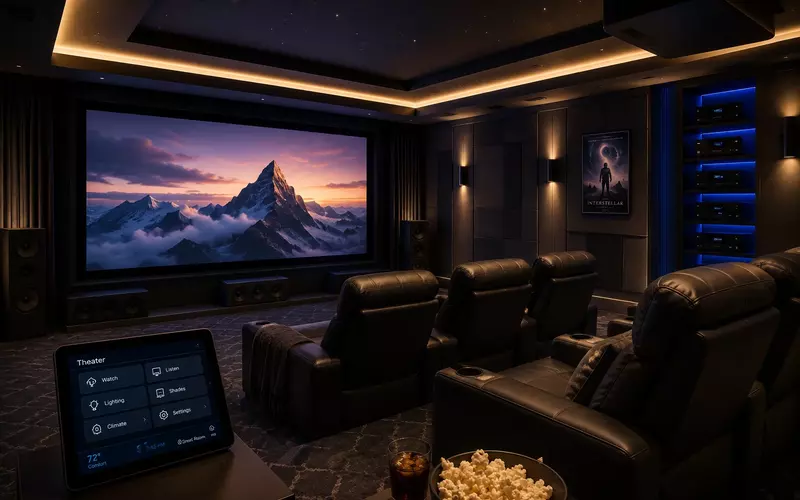
A true home theater is far more than a large television and surround speakers. Every successful theater begins with careful planning: room dimensions, acoustic treatment, lighting, seating, wiring infrastructure, equipment placement, and automation all work together to create an experience that rivals commercial cinemas while remaining comfortable enough for everyday family use.
Many homeowners begin by shopping for displays or speakers, only to discover later that poor room acoustics, incorrect seating positions, or insufficient wiring prevent the system from reaching its full potential.
Whether you're building a dedicated cinema, finishing a basement, or integrating a media room into a new luxury home, understanding the design principles before construction begins can save thousands of dollars while producing dramatically better results.
Start With the Room, Not the Equipment
The room itself determines more of your viewing experience than many people realize. Nearly every surface affects sound reflections and image quality.
- Room dimensions
- Ceiling height
- Wall construction
- Floor materials
- Window placement
- Mechanical noise
- HVAC design
Dedicated theater rooms allow complete optimization, while multipurpose media rooms require balancing aesthetics with performance.
Early collaboration between architects, builders, and AV designers makes it possible to hide speakers, route cables properly, reduce unwanted noise, and prepare infrastructure before drywall is installed.
Choosing the Right Display
Modern theaters generally use one of two approaches.
Large flat-panel displays
Large televisions are ideal for bright rooms, everyday television, gaming, sports, and projects where lower maintenance matters. Their advantages include excellent HDR performance, high brightness, minimal maintenance, fast startup, and lower installation complexity.
Front projection systems
Projection remains the preferred choice for dedicated cinemas. It enables larger screen sizes, more cinematic viewing angles, greater immersion, and clean room aesthetics.
Projection systems require careful planning around throw distance, ceiling height, ambient light, screen material, and projector ventilation. Professional calibration becomes increasingly important as screen sizes grow.
Screen Size and Viewing Distance
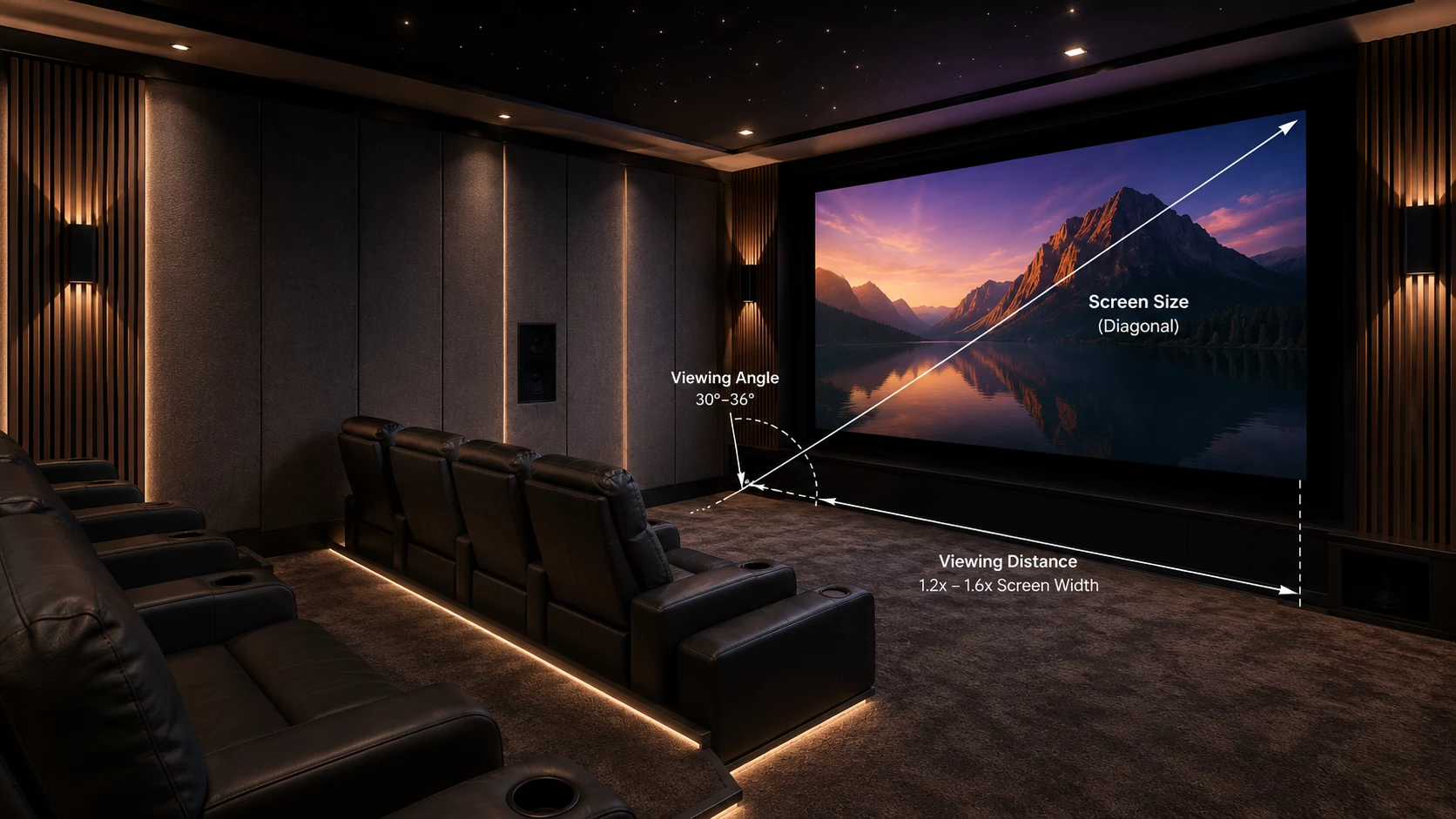
Bigger isn't always better. The ideal viewing distance depends on screen size, resolution, viewing angle, and seating layout.
Professional designers typically begin by selecting the primary seating location before determining the optimal screen dimensions. A properly designed theater should allow every seat to enjoy a comfortable neck position, full screen visibility, balanced audio, and clear sightlines.
Designing Immersive Audio
Modern surround sound is no longer limited to speakers placed around the room. Formats like Dolby Atmos introduce overhead sound that creates convincing three-dimensional immersion.
Typical speaker layouts include 5.1, 7.1, 5.1.2, 7.1.4, and larger immersive systems for dedicated theaters. The correct configuration depends on room dimensions, ceiling construction, seating positions, budget, and intended listening levels.
Proper speaker placement often has a greater impact than purchasing more expensive equipment.
Acoustics Matter More Than Most Equipment Upgrades
One of the most common mistakes is ignoring room acoustics. Even premium speakers perform poorly inside untreated rooms.
Reflection control
Reducing early reflections improves dialogue clarity and prevents hard surfaces from making the room sound harsh or indistinct.
Bass management
Low frequencies require careful planning to avoid room resonances, dead spots, and excessive boominess. Multiple subwoofers often provide smoother bass than a single larger unit.
Sound isolation
Dedicated theaters should minimize sound transfer to adjacent rooms through coordinated wall construction, insulation, floating floors, acoustic doors, and ceiling isolation. Planning these features during construction is significantly easier than retrofitting them later.
Lighting Design
Lighting dramatically affects perceived image quality. Effective theater lighting typically includes dimmable fixtures, cove lighting, step lighting, accent lighting, and equipment-rack lighting.
Useful scenes may include Movie Mode, Intermission, Cleaning, Entertain, and Gaming. Modern lighting systems can automatically coordinate these scenes with the theater control system.
Seating Layout
Comfort is only one part of seating design. Professional planning considers viewing angles, eye height, speaker alignment, walkways, recliner clearance, and second-row risers.
Every seat should maintain a consistent experience without blocking other viewers.
Equipment Rack and Network Infrastructure
Equipment rack planning
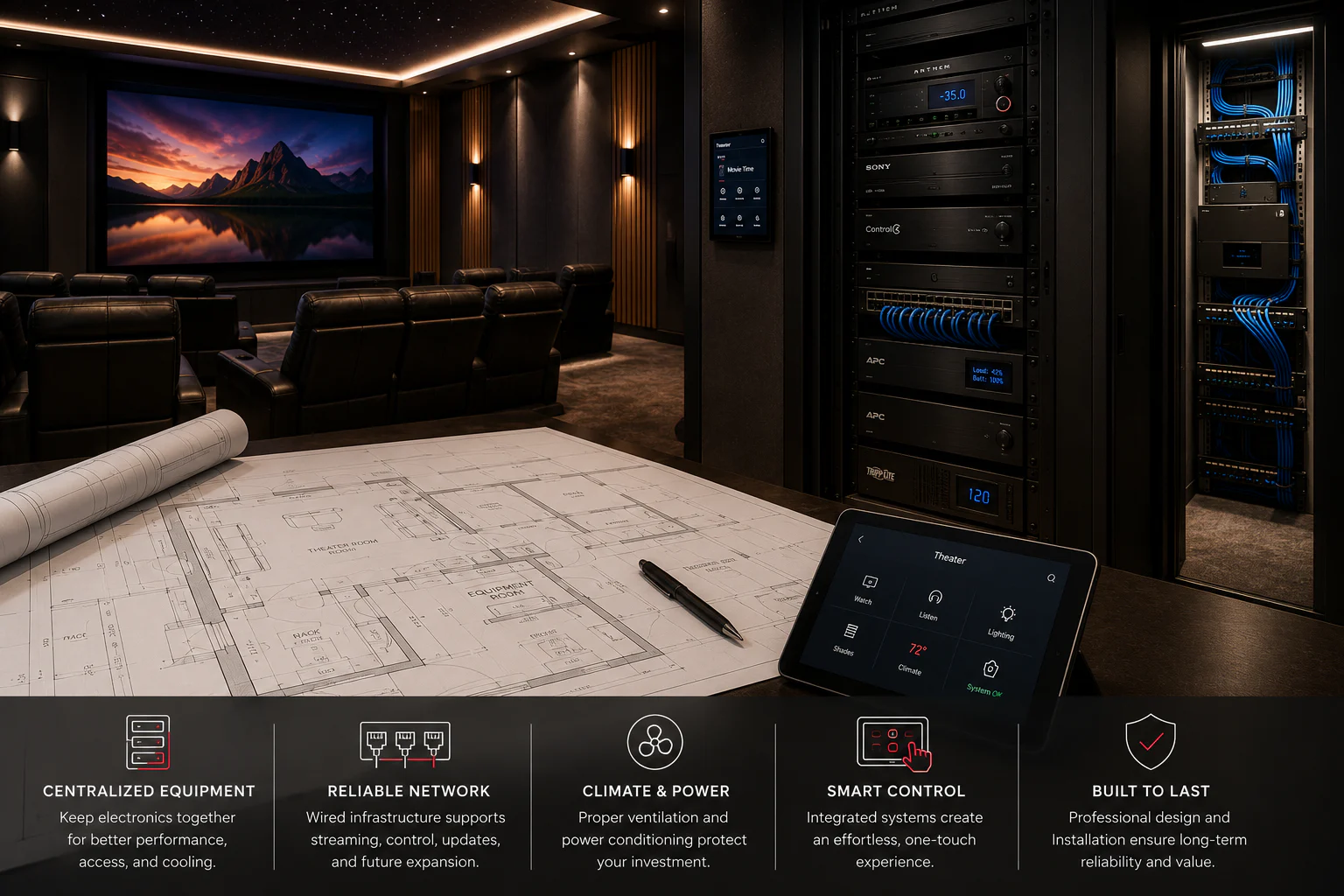
Rather than placing equipment throughout the room, many high-end theaters centralize electronics inside a dedicated equipment rack. Typical components include an AV receiver or processor, amplifiers, network switches, streaming devices, media servers, power conditioning, UPS systems, and automation processors.
Separating equipment reduces noise, simplifies maintenance, and improves cooling.
Network infrastructure
Today's theaters rely heavily on networking. Streaming services, media servers, automation systems, remote diagnostics, firmware updates, and whole-home integration all depend on a reliable network.
Professional installations typically include dedicated Ethernet wiring, high-performance switches, structured cabling, equipment labeling, and future expansion capacity. Wi-Fi alone should never be considered the primary backbone for a premium theater installation.
Automation and Control
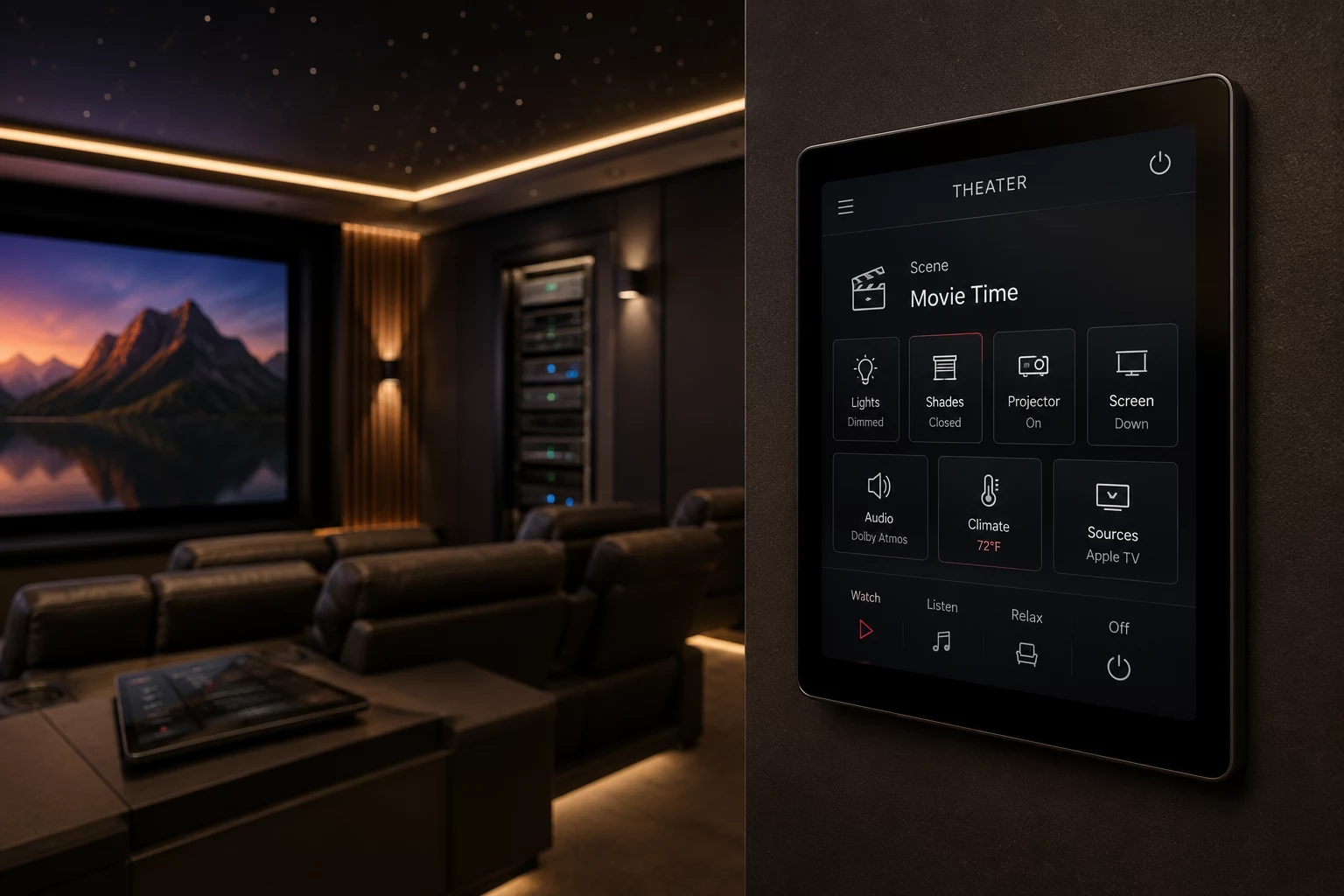
A modern theater should feel effortless. Instead of juggling multiple remotes, a single interface can coordinate the display or projector, audio system, lighting, shades, climate, and source selection.
One button can transform the room: the lights dim, shades close, projector powers on, audio activates, and the correct input is selected. Automation reduces complexity while improving everyday usability.
Plan for the Future
Technology changes faster than construction. Professional infrastructure planning anticipates future upgrades by including extra conduit, additional network drops, flexible rack space, spare electrical capacity, service access, and expandable speaker wiring.
Preparing the room during construction costs very little compared with reopening finished walls later.
Common Home Theater Mistakes
Many expensive problems originate during construction rather than equipment selection. Most can be avoided through early planning.
- Choosing equipment before designing the room
- Ignoring acoustics
- Poor speaker placement
- Insufficient electrical circuits
- No equipment ventilation
- Limited cable pathways
- Inadequate networking
- Poor lighting control
- Incorrect seating distances
- No allowance for future upgrades
Working With an Experienced Integration Partner
Designing a premium home theater requires coordination across multiple trades. A professional integration team works alongside architects, builders, electricians, HVAC contractors, and interior designers to ensure every system functions together from the beginning.
Rather than recommending equipment alone, experienced integrators develop complete system designs that balance performance, aesthetics, reliability, and long-term serviceability. This coordinated approach minimizes surprises during construction and results in a theater that performs as intended from day one.
Frequently Asked Questions
How much does a custom home theater cost?
The cost depends on the room, screen size, audio configuration, acoustic treatment, seating, lighting, control system, and construction requirements. A professionally designed theater may range from a relatively simple media room to a fully isolated, acoustically engineered private cinema. The most reliable budget is created after reviewing the room and defining the desired experience.
What is the ideal room size for a home theater?
There is no single ideal size. A successful theater can be created in many different rooms, but the room's width, length, and ceiling height affect seating, screen size, speaker placement, and bass performance. Rooms with balanced proportions are generally easier to optimize than perfectly square spaces.
Should I choose a projector or a large television?
A large television is usually better for bright rooms, everyday viewing, sports, and gaming. A projector is often the better choice for a dedicated theater where a larger, more cinematic image is the priority. Ambient light, viewing distance, screen size, and room aesthetics should guide the decision.
How far should seating be from the screen?
The correct distance depends on screen size, resolution, and the desired viewing angle. Seating should feel immersive without requiring viewers to move their heads excessively or strain their eyes. The primary seating position should be established before the final screen size is selected.
How many speakers does a home theater need?
A basic surround system may use five speakers and one subwoofer, while immersive systems can include seven or more ear-level speakers, multiple subwoofers, and overhead channels. The best configuration depends on the room, number of seats, desired performance, and available construction space.
Is Dolby Atmos worth adding?
Dolby Atmos can significantly improve immersion by adding sound above the listener. It is especially effective in dedicated theaters and rooms where overhead speakers can be positioned correctly. Poorly placed Atmos speakers, however, may provide less benefit than a properly designed conventional surround system.
Do I need acoustic treatment?
Most rooms benefit from acoustic treatment. Untreated walls, ceilings, floors, and windows can create echoes, harsh reflections, and uneven bass. Proper treatment improves dialogue clarity, sound balance, and consistency between seats without making the room feel unnaturally quiet.
How many subwoofers should a home theater have?
One subwoofer may be sufficient for a smaller room, but two or more properly positioned subwoofers often produce smoother and more consistent bass across multiple seats. The goal is not simply greater volume but better low-frequency coverage throughout the room.
Can a home theater also be used as a media room?
Yes. A media room can support movies, television, music, gaming, and entertaining. However, multipurpose rooms usually require compromises involving light control, speaker visibility, furniture placement, and acoustic performance. These tradeoffs should be addressed during the initial design.
Can speakers and equipment be hidden?
Many components can be concealed using in-wall or in-ceiling speakers, acoustically transparent screens, custom cabinetry, recessed lighting, and remote equipment racks. Concealment should be planned carefully so it does not restrict sound, ventilation, service access, or future upgrades.
Does a home theater require special electrical wiring?
A premium theater may require dedicated electrical circuits, surge protection, power conditioning, equipment-grounding considerations, and backup power for critical components. Electrical planning should be coordinated before walls and ceilings are finished.
Why is a wired network important?
Streaming devices, control processors, receivers, projectors, media servers, and remote-support tools depend on a stable network connection. Wired Ethernet is generally more reliable than Wi-Fi for fixed theater equipment and reduces the risk of interruptions during playback.
Can the theater be controlled from one remote or app?
Yes. A professionally integrated control system can combine the display, audio, lighting, shades, climate, and source selection into one interface. A single command can prepare the entire room for movies, gaming, music, or everyday television.
When should a home theater designer become involved?
The best time is before construction or renovation begins. Early involvement allows the designer to coordinate room proportions, electrical service, HVAC, wiring, speaker locations, lighting, equipment ventilation, acoustic isolation, and future expansion before changes become expensive.
How long does a home theater installation take?
The timeline depends on the project scope. A straightforward media-room upgrade may be completed relatively quickly, while a dedicated theater involving construction, acoustic treatment, custom millwork, lighting, automation, and calibration can take significantly longer. The AV schedule should be coordinated with the broader construction plan.
Can an existing room be converted into a home theater?
Yes. Bedrooms, bonus rooms, basements, garages, and living spaces can often be converted. The main considerations are room dimensions, window control, sound isolation, HVAC noise, electrical capacity, cable access, and available space for seating and equipment.
How should I prepare a home theater for future upgrades?
Include conduit, spare network cables, additional speaker wiring, rack space, accessible cable paths, and sufficient electrical capacity. Infrastructure is inexpensive to add during construction and difficult to retrofit after the room is complete.
Design a Theater That Lasts
The best home theaters are designed long before the first speaker or display is installed. Room geometry, acoustics, infrastructure, lighting, networking, and automation all contribute to the final experience. Investing in thoughtful planning creates a space that delivers exceptional performance today while remaining adaptable for future technologies.
Whether you're building a dedicated cinema or upgrading a multifunction media room, approaching the project as an integrated system—not a collection of individual products—will produce better results and greater long-term value.
At AVgator, we help homeowners, architects, builders, and interior designers throughout the Charlotte region plan and integrate home theaters that combine outstanding performance with intuitive operation. From infrastructure design and equipment coordination to automation, commissioning, and long-term support, our focus is on creating systems that fit both the home and the people who use them.
Schedule a project consultation with AVgator to discuss your room, construction timeline, and goals.