How to Plan Smart Lighting Scenes
Build useful scenes around real routines, layered lighting, daylight, and intuitive wall-station behavior.
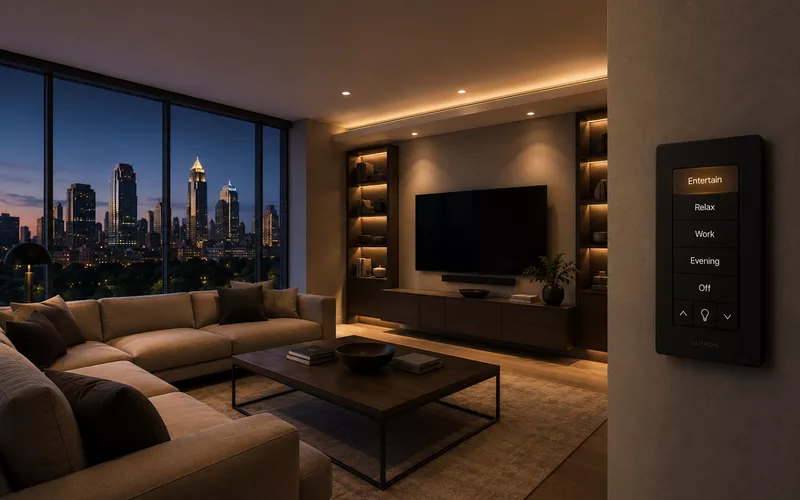
The real value of smart lighting is not an app or a collection of connected bulbs. It is a set of carefully planned scenes that makes daily routines simpler while improving comfort, efficiency, and architectural design.
A successful scene can coordinate multiple fixtures, motorized shades, and even audiovisual or climate systems with one button or scheduled event. Instead of managing individual switches, occupants choose the environment they want.
What Is a Lighting Scene?
A lighting scene is a predefined combination of lighting levels, fixture groups, and sometimes shade positions that can be recalled instantly. Residential examples include Welcome Home, Morning, Cooking, Dining, Movie Night, Entertain, Good Night, and Away. Commercial spaces might use Presentation, Video Conference, Collaboration, Reception, Cleaning, and After Hours.
The objective is consistency, simplicity, and comfort—not complexity.
Design Scenes Around Daily Life
Begin with how people actually live, work, and move through the property. Ask what happens when someone arrives, which rooms are used together, how the home transitions into evening, which activities need focused light, and where occupants spend their time.
A Morning scene might gradually illuminate bedrooms, hallways, bathrooms, and the kitchen while opening shades. An Evening scene can soften light throughout the home and prepare entertainment spaces for relaxation.
Layer Lighting Instead of Treating Every Fixture Equally
General illumination from downlights, ceiling fixtures, and coves.
Focused light for counters, vanities, islands, reading, and desks.
Light that reveals artwork, shelves, fireplaces, stone, and architectural niches.
Chandeliers, pendants, and sconces that contribute both character and illumination.
Scenes should balance these layers as a composition. That flexibility allows the same room to support work, entertaining, cleaning, and quiet evenings without exposing users to every underlying circuit.
Think Beyond Individual Rooms
Traditional switching encourages room-by-room thinking. Integrated control lets scenes follow activities across the property.
- Morning Routine: bedroom, bathroom, hallway, and kitchen.
- Evening Arrival: exterior, entry, hallway, kitchen, and family room.
- Good Night: first-floor lights off, halls and stairs dimmed, security lighting retained, and shades closed.
Use Daylight to Your Advantage
Natural daylight is part of the lighting design. A coordinated system can dim fixtures during bright afternoons, compensate on cloudy days, adapt to seasonal changes, and balance motorized shades with interior light.
This approach—often called daylight harvesting—can improve comfort and reduce unnecessary energy use. It works best when window orientation, shade fabric, fixtures, sensors, and control intent are evaluated together early.
Keep Wall Controls Simple
Overcrowded wall stations create friction. A short list such as Welcome, Relax, Entertain, and All Off can control many zones behind the scenes while remaining obvious to family, guests, and employees.
Automation should enhance daily life without removing control. Schedules, occupancy and daylight sensors, wall stations, apps, and voice assistants can coexist, but every automated behavior needs an easy manual override.
Coordinate Lighting With Other Systems
Lighting scenes become more valuable when integrated with shades, HVAC, security, locks, landscape lighting, whole-home audio, and theater equipment. A Movie Night scene might dim lights, lower shades, start the display and sound system, adjust temperature, and retain subtle pathway lighting.
The scene should support the activity rather than showcase the technology.
Plan for Change
Families, room uses, furniture, and workplace routines evolve. Plan spare control capacity, expandable programming, documented circuits, modular hardware, and infrastructure for future integrations so scenes can change in software instead of requiring new electrical work.
Common planning mistakes
- Treating every fixture as an isolated switch
- Ignoring daylight
- Overcrowding wall stations
- Failing to separate lighting layers
- Programming before learning routines
- Using incompatible dimmers or LED drivers
- Missing system documentation
- Automating without manual overrides
Infrastructure Matters
Useful scenes depend on more than programming. Coordinate control-panel locations, electrical loads, dimming methods, LED drivers, low-voltage pathways, networking, emergency requirements, and broader building automation during design.
AVgator works with homeowners, architects, builders, electricians, developers, and interior designers on lighting-control design, routine-based scene planning, shading, AV integration, programming, commissioning, documentation, and long-term support.
Start with real activities, compose the lighting layers, then design the simplest control surface that can reliably recall them.
Frequently Asked Questions
What is a smart lighting scene?
A smart lighting scene is a predefined combination of fixture groups and brightness levels recalled with one button, schedule, sensor, app, or voice command.
How many lighting scenes should a home have?
Many professionally designed homes use six to twelve primary scenes, though the right number depends on the property and the routines each space supports.
Should lighting scenes include motorized shades?
Often, yes. Coordinating shades with artificial lighting improves comfort, privacy, daylight control, and energy performance.
Can an existing home be upgraded with smart lighting scenes?
Many can. The best approach depends on existing wiring, fixtures, controls, and the desired level of automation.
Are smart lighting scenes energy efficient?
They can reduce unnecessary energy use through dimming, occupancy response, schedules, and daylight harvesting while maintaining comfortable illumination.
What is the difference between a lighting scene and a schedule?
A scene defines how lights behave; a schedule determines when that scene runs automatically. The same scene can also remain available for manual activation.
Should every room have its own wall controls?
Not necessarily. A few activity-based scene buttons are often easier to understand than a bank of switches for individual fixtures.
Can smart lighting integrate with security and home automation?
Yes. Lighting can coordinate with security, HVAC, shades, AV equipment, door locks, landscape lighting, and other building systems.
When should lighting scenes be planned during construction?
During architectural and electrical design, before construction. Early planning aligns fixtures, circuits, control hardware, networking, and shading.
Why use a professional lighting-control designer?
A professional coordinates real routines, lighting layers, compatible electrical hardware, intuitive controls, automation, documentation, and future expansion as one reliable system.
Lighting That Feels Natural
A good lighting-control system disappears into the rhythm of the space. It is intuitive on day one, adaptable years later, and coordinated with the architecture rather than added after it.
Schedule a smart-lighting consultation for a new home, renovation, office, or commercial project in Charlotte and the surrounding region.