Motorized Shades: Are They Worth It?
Where automated shading adds meaningful comfort, privacy, energy performance, and protection for interiors.
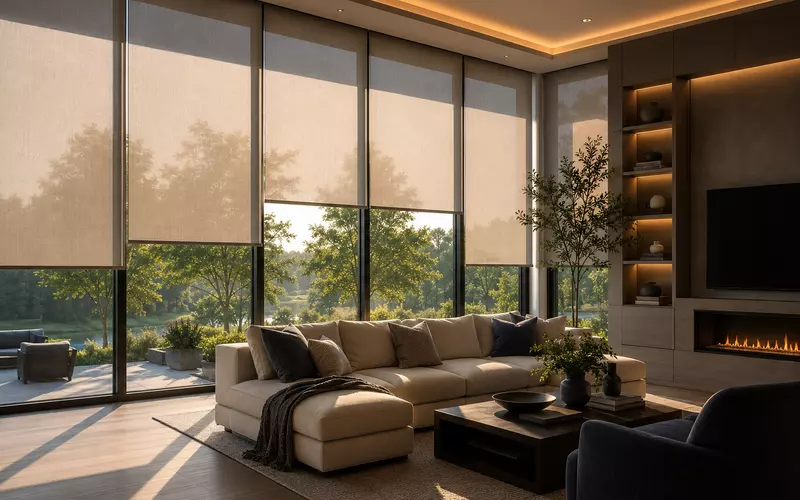
Motorized shades are often presented as a luxury convenience, but their value extends far beyond opening and closing window coverings with a button. A well-designed system can improve comfort, protect interiors, support heating and cooling, increase privacy, and coordinate naturally with lighting and automation.
The key question is whether shades solve meaningful problems in the space. Large or difficult-to-reach glass, strong afternoon sun, changing privacy needs, theater blackout, and whole-property automation are all situations where motorization provides practical daily value.
What Are Motorized Shades?
Motorized shades use an integrated electric motor to raise, lower, tilt, or position roller shades, drapery tracks, Roman or cellular shades, Venetian blinds, exterior screens, skylight shades, blackout systems, and dual-shade assemblies.
Control may come from wall keypads, remotes, apps, touchscreens, voice assistants, schedules, light or occupancy sensors, smart-home scenes, and building-automation systems. The most useful designs combine immediate local control with restrained automation that responds to time, sunlight, occupancy, and room use.
When Motorized Shades Add the Most Value
Motorization is especially valuable for large expanses of glass, floor-to-ceiling or double-height windows, skylights, theaters, bedrooms requiring blackout, west-facing rooms, conference rooms, offices, hospitality spaces, and properties with extensive automation.
One command can adjust a room, floor, residence, commercial property, or multiple buildings. More importantly, automation adds consistency: shades do not remain open during damaging sun or closed long after privacy is needed simply because someone forgot them.
Comfort, Privacy, Protection, and Energy Performance
Managing glare
Direct sun can interfere with televisions, computer work, video calls, reading, dining, and artwork. Selective automation can lower only shades affected by afternoon sun, preserving daylight elsewhere instead of darkening the room.
Improving privacy
Street-facing shades can close at sunset, bedroom shades can lower at night, and selected windows can respond to Away or meeting modes. Daytime privacy must be evaluated separately from nighttime privacy because many open-weave fabrics become transparent when interior lights are on.
Protecting interiors
Sunlight and heat gradually affect flooring, rugs, upholstery, artwork, cabinetry, leather, and decorative finishes. Automated shades cannot eliminate fading, but they reduce unnecessary direct exposure during the most intense parts of the day.
Supporting energy performance
Shade position can respond to orientation, exterior and interior temperature, HVAC mode, occupancy, daylight, and season. West-facing shades, for example, can lower during peak afternoon heat. Results depend on glazing, orientation, fabric, climate, controls, and HVAC design; shades complement rather than replace a high-performance envelope.
Daylight harvesting
Coordinated shading and lighting can limit glare, reduce electric-light output, maintain comfortable brightness, protect displays and work surfaces, and preserve views. The objective is balance—not maximum daylight at all times.
Home-Theater and Blackout Performance
Daylight reduces image contrast in theaters and media rooms. Movie mode can lower blackout shades, set lighting, and start the AV system. Near-total darkness usually requires opaque fabric plus side, headbox, and sometimes sill channels, overlapping coverage, and carefully detailed pockets.
A standard roller shade has side clearances for fabric movement and should not be represented as a complete blackout solution without those surrounding details.
Dual Shades, Fabric Openness, and Exterior Systems
Dual-shade systems
A dual assembly commonly pairs a daytime solar screen with a privacy or blackout shade. It preserves daylight and views when possible while providing darkness or privacy when needed. Dual rollers require more pocket space, power, wiring, and coordination.
Fabric openness
Lower openness generally delivers more privacy and glare control with less outward visibility and daylight. Higher openness preserves views and light but offers less privacy and glare protection. Samples should be reviewed under actual daytime and nighttime conditions.
Interior versus exterior shades
Interior shades are protected from weather, easier to install, and available in many finishes. Exterior shades can block solar heat before it reaches the glass and improve patio comfort, but must account for wind, rain, corrosion, structural loads, safe retraction, and weather-rated hardware.
Wired Versus Battery Power and Control
Wired shades
Wired motors are usually preferred in new construction and large integrated projects because they avoid battery replacement, support larger shades, simplify central power, and enable stronger monitoring and integration. They require early coordination for cabling, power supplies, panels, junctions, and service access.
Battery-powered shades
Battery systems reduce construction impact in existing spaces. Tradeoffs include battery maintenance, motor-size limitations, less frequent communication, and reduced suitability for heavy or highly active shades.
Wireless versus wired control
Wireless control may use proprietary radio, Wi-Fi, Zigbee, Z-Wave, Thread, or another low-power method. Wired control may use a dedicated bus, low-voltage cable, network, dry contacts, or automation interfaces. Project size, materials, reliability, compatibility, and service expectations determine the right approach.
Shade Pockets and Architectural Integration
Recessed pockets can conceal rollers and hardware, but must account for tube and motor diameter, shade width, fabric thickness, fascia, dual rollers, side channels, mounting tolerances, ceiling finish, window trim, and service access. A pocket that is too small can make installation or repair impossible.
Surface-mounted shades are easier to retrofit and service and can still look intentional with a well-designed fascia. The architect, designer, builder, window-treatment specialist, electrician, and integrator should coordinate before framing and ceilings are final.
Noise, size, and alignment
Motor volume, speed, smoothness, and synchronized motion matter in bedrooms, theaters, hospitality, and boardrooms. Large shades require appropriate tube stiffness, brackets, mounting structure, motor torque, and fabric weight. Very wide openings may be better served by coupled or multiple panels than one oversized shade.
Integration, Sensors, and Scenes
Shades become more useful when coordinated with lighting, HVAC, security, occupancy, AV, access, schedules, and weather. Morning can open bedroom shades and set lights and temperature; Away can close privacy shades and arm security; Movie can lower blackout shades and start AV; Presentation can manage solar shades, lighting, displays, and conferencing.
Sunlight, temperature, occupancy, astronomical schedules, weather, and wind can trigger movement. Automation needs sensible limits and overrides so shades do not move too often or surprise occupants. Astronomical schedules are especially useful because sunrise and sunset shift throughout the year.
Local control remains essential. Every room should provide an obvious way to raise, lower, stop, choose a preferred position, and temporarily override automation—often through a clearly labeled wall keypad.
Safety and Offline Operation
Motorization can remove accessible cords, improving child and pet safety, but installations must still consider pinch points, furniture, secure mounting, safe limits, and obstruction detection where available.
Local keypads, direct controls, remotes, manual mechanisms, or stored schedules should preserve reasonable operation when a network, cloud service, or central controller is unavailable. Most wired shades stay in their current position during an outage; backup power can be reserved for windows with a defined security, privacy, medical, or operational need.
Maintenance, Lifespan, and Commissioning
Long-term service may include battery replacement, fabric cleaning, limit adjustment, motor or track service, reprogramming, alignment correction, updates, and sensor calibration. Hardware must remain accessible.
Motor quality, shade size and weight, daily cycles, installation, environment, maintenance, and power quality all affect lifespan. Undersized motors, misaligned brackets, overloaded rollers, and inaccessible pockets shorten service life.
Commissioning should verify direction, limits, alignment, fabric tracking, noise, keypad and group commands, scenes, schedules, sensor responses, communication, overrides, and safety functions under realistic conditions.
Cost, Retrofits, and Where Motorization Fits
Motorized shades cost more because the project includes motors, controls, power, cabling, programming, integration, specialized installation, and architectural coordination. Window dimensions, fabric, shade and motor type, control platform, pockets, blackout details, access, and integration determine final cost.
Small, reachable windows that rarely change may not justify motorization. A mixed approach can prioritize high windows, bedrooms, theaters, large glass, and areas with significant glare or privacy needs while using manual treatments elsewhere.
New construction offers the best opportunity to coordinate pockets, wiring, side channels, control panels, and equipment. Existing properties can use battery motors, wireless control, selective wiring, surface fascias, and decorative enclosures.
Common Motorized-Shade Mistakes
- Selecting shades after framing and ceilings are complete
- Providing no power or making pockets too small
- Choosing fabric only for appearance or ignoring nighttime privacy
- Expecting standard rollers to deliver total blackout
- Ignoring side gaps, trim, handles, motor sizing, or service access
- Relying entirely on a mobile application
- Using indoor products outside or oversizing a single shade
- Adding excessive automation without practical overrides
- Skipping calibration and system documentation
Motorized shades offer the strongest value when they solve recurring problems: difficult access, glare, changing privacy, interior protection, theater darkness, many windows, or coordinated energy and smart-home operation.
Working with an Integration Partner
Successful shading coordinates homeowners or operators, architects, interior and lighting designers, window-treatment specialists, builders, electricians, HVAC teams, and integrators. The plan should define motors, power, pockets, keypads, scenes, sensors, HVAC and lighting behavior, commissioning, documentation, and support.
Explore AVgator's lighting-control services and Lutron integration capabilities.
Frequently Asked Questions
Are motorized shades worth the cost?
They can be when they improve daily comfort, privacy, glare control, interior protection, or energy performance. Value is greatest with many windows, large glazing areas, or hard-to-reach shades.
How much do motorized shades cost?
Cost depends on window size, fabric, motor, control system, pocket design, wiring, installation access, and integration. Large blackout and recessed systems generally cost more than simple battery-powered roller shades.
Do motorized shades require electrical wiring?
Not always. Some use batteries, while others use low- or line-voltage power. Wired systems are generally preferred for new construction, large shades, and whole-property automation.
How often do battery-powered shades need new batteries?
Battery life depends on shade size, motor efficiency, battery type, wireless communication, and movement frequency. Larger and frequently used shades may need more regular replacement.
Can motorized shades work during a power outage?
Most wired shades remain in their current position during an outage. Selected shades can be connected to backup power when continued operation is important.
Are motorized shades noisy?
Noise varies by motor and installation. Premium motors can be very quiet, while larger or poorly installed shades may be more noticeable, especially in bedrooms, theaters, and boardrooms.
Can motorized shades provide complete blackout?
Standard roller shades usually leave side light gaps. True blackout typically requires opaque fabric, side channels, headboxes, and coordinated architectural details.
What is a dual-shade system?
It installs two shades at one window, commonly a daytime solar screen plus a blackout or privacy shade.
Can motorized shades protect furniture from fading?
They reduce direct sunlight and ultraviolet exposure, helping protect flooring, rugs, artwork, upholstery, and finishes. They cannot prevent all fading.
Do shades improve energy efficiency?
They can manage solar heat gain and help reduce heating or cooling loads. Results depend on the window, fabric, climate, schedule, and automation strategy.
Can shades move automatically based on sunlight?
Yes. They can respond to sunlight sensors, astronomical schedules, solar position, temperature, or weather data.
Can shades be controlled from a phone?
Yes, although wall keypads or other local controls should still be provided for dependable everyday use.
Can motorized shades integrate with lighting?
Yes. Shades and lighting can operate together in scenes such as Morning, Away, Movie, Presentation, and Sunset.
Can motorized shades integrate with HVAC?
Yes. Shade position can coordinate with heating and cooling strategies to reduce solar heat gain and improve comfort.
Are motorized shades safe for children and pets?
They can improve safety by eliminating accessible cords. Installation should still address pinch points, secure mounting, and safe motor limits.
Should motorized shades be planned before construction?
Yes. Early planning allows proper pockets, wiring, power supplies, side channels, service access, and control integration.
Can motorized shades be added to an existing home?
Yes. Battery motors, wireless controls, selective wiring, and surface-mounted fascias make many retrofit installations possible.
How long do motorized shades last?
Service life depends on motor quality, shade size, installation, daily use, and maintenance. Properly specified systems can operate reliably for many years.
What happens if the automation system fails?
A good design preserves local operation through keypads, direct motor controls, remotes, or stored motor commands, depending on the platform.
Do all shades in the house need to be motorized?
No. Many projects prioritize large openings, bedrooms, theaters, high windows, and spaces with significant sun or privacy needs.
Shading That Belongs to the Architecture
Motorized shades are worthwhile when they provide meaningful comfort, privacy, protection, energy support, or room performance. The best results depend on early decisions about fabric, pockets, motor sizing, power, wiring, controls, access, and commissioning.
AVgator designs and integrates motorized shading, lighting, automation, networking, AV, and building controls for residential and commercial properties in Charlotte and beyond. Schedule a project consultation.