Why Conference Room Audio Matters More Than Video
Clear speech is the foundation of equitable hybrid meetings. Here's how acoustics, microphone design, and DSP create productive collaboration.
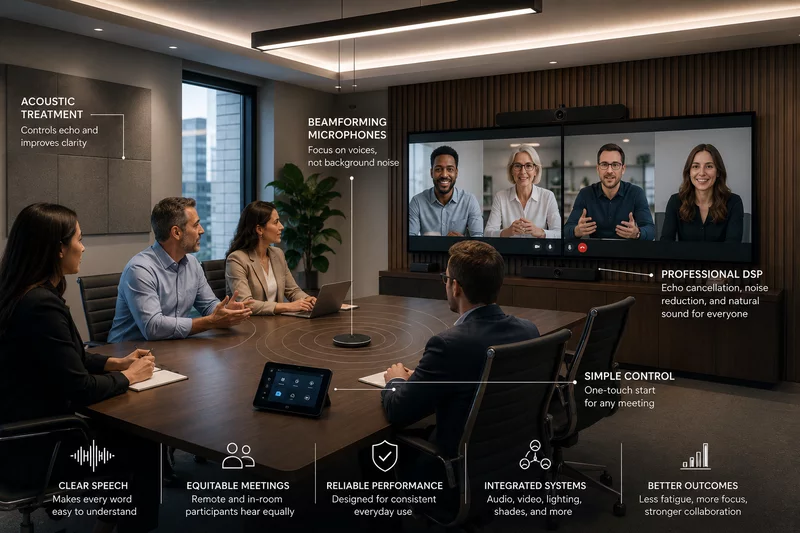
Video conferencing has transformed the workplace, but displays and high-resolution cameras do not determine whether communication succeeds. If participants cannot understand one another, even excellent video becomes secondary.
At AVgator, we design conference room technology around a simple principle: people need to hear each other before they can collaborate effectively. Natural speech depends on the room, microphones, loudspeakers, digital signal processing, networking, and control working as one system.
Communication Begins With Speech
Most meeting content is spoken. Whether teams are reviewing reports, discussing engineering changes, negotiating contracts, or presenting ideas, understanding every word is essential.
- Participants repeatedly ask others to repeat themselves.
- Conversations become slower and less productive.
- Remote attendees disengage.
- Meeting fatigue increases.
- Important details can be misunderstood.
High-quality audio helps every participant contribute equally, regardless of location.
Hybrid Meetings Depend on Audio Quality
In a traditional meeting, everyone shares the same acoustic environment. Hybrid meetings include participants in the room and others joining from homes, offices, airports, or hotels. The challenge is no longer simply amplifying voices inside one space.
Meeting equity means remote attendees can hear, speak, and participate as naturally as people in the room. A successful design evaluates the experience of every participant, not only those seated around the table.
The Room Is Part of the Audio System
Microphones alone do not determine quality. Glass walls, concrete floors, drywall ceilings, and large tables reflect sound around the room, reducing speech clarity and making conversations harder to follow.
Professional planning considers reverberation time, background noise, ceiling height, furniture, acoustic treatment, HVAC noise, and windows. Improving the acoustic environment can deliver greater benefits than purchasing more expensive electronics.
Microphone Selection and Placement
Microphone location determines how effectively voices are captured. The choice should follow room geometry, seating, ceiling construction, aesthetics, and meeting style.
Support clean aesthetics and flexible seating arrangements.
Suit traditional conference tables with predictable seating.
Focus electronically on active talkers while reducing unwanted noise.
Support training, presentations, and larger flexible rooms.
Understanding Digital Signal Processing
DSP is the intelligence behind a professional conference room audio system. It continuously analyzes signals and improves clarity without requiring users to adjust technical settings during a call.
- Acoustic echo cancellation
- Automatic gain control
- Noise reduction and feedback suppression
- Equalization and microphone mixing
- Audio routing
Echo cancellation is essential
Echo occurs when room loudspeakers are captured by microphones and sent back to remote participants. Properly configured acoustic echo cancellation removes that return signal before it leaves the room. Without it, even expensive equipment can perform poorly.
Loudspeakers Should Sound Natural
Conference room loudspeakers are designed for intelligible speech, not maximum volume. Coverage, ceiling height, seating, background noise, zoning, and speech intelligibility all influence placement.
Distributed sound often works better than a single loudspeaker at one end of the room because participants hear remote voices at a consistent, natural level.
Control Should Be Simple and Integrated
Technology should not distract from the meeting. Displays, cameras, microphones, audio levels, lighting, shades, and conferencing platforms should operate through a single intuitive touch panel or room controller.
A single command can power displays, activate cameras and microphones, lower shades, set lighting, select the conferencing platform, and configure room audio.
Automating routine tasks starts meetings faster, reduces support calls, and delivers a consistent experience from room to room.
Scalability and Future Growth
Organizations rarely stop with one meeting room. Standards should support huddle rooms, medium conference rooms, boardrooms, training spaces, multipurpose rooms, and divisible spaces while keeping controls familiar.
Infrastructure should also accommodate additional displays, new conferencing platforms, AI meeting assistants, advanced cameras, expanded microphone coverage, and future network upgrades. Flexibility today reduces renovation costs tomorrow.
Common Conference Room Audio Mistakes
- Prioritizing displays over acoustics
- Using consumer-grade microphones
- Ignoring reverberation and HVAC noise
- Providing uneven loudspeaker coverage
- Skipping DSP tuning and commissioning
- Creating inconsistent room standards
- Installing complicated controls
- Leaving systems undocumented
How AVgator Helps
AVgator combines professional audio, video, networking, automation, and room control into one meeting experience. Every project begins with how the space will be used, who will participate, and what level of collaboration the organization expects.
Our work can include conference room AV design, DSP configuration, microphone and loudspeaker design, acoustic consultation, video conferencing, displays, room-control programming, lighting and shade integration, networking, commissioning, documentation, and ongoing support.
Frequently Asked Questions
Why is conference room audio more important than video?
People can often continue a meeting with average video, but unclear audio makes communication difficult or impossible. Intelligible speech improves understanding, reduces fatigue, and helps every participant contribute.
What is DSP in a conference room?
Digital signal processing improves speech through functions such as acoustic echo cancellation, noise reduction, automatic gain control, microphone mixing, equalization, and audio routing.
What causes poor conference room audio?
Common causes include excessive reverberation, background noise, poor microphone placement, uneven loudspeaker coverage, inadequate acoustic treatment, and improperly configured DSP.
Do conference rooms need acoustic treatment?
Many do. Glass, concrete, drywall, and large tables reflect sound. Acoustic panels, ceiling treatments, soft finishes, and thoughtful furniture placement can substantially improve speech clarity.
Which microphone type is best for conference rooms?
The right choice depends on room size, seating layout, ceiling construction, aesthetics, and meeting style. Ceiling, beamforming, tabletop, and wireless microphones each suit different applications.
Can conference room audio integrate with lighting and room controls?
Yes. Audio can coordinate with displays, cameras, lighting, shades, occupancy sensors, and conferencing platforms so a room enters Meeting Mode with one command.
How can businesses improve hybrid meetings?
Clear audio, controlled acoustics, professional DSP, reliable networking, intuitive controls, appropriate camera design, and consistent room standards all improve the experience for local and remote participants.
When should conference room AV systems be planned?
Whenever possible, during architectural and construction planning so power, pathways, networks, equipment, acoustics, furniture, and mounting locations can be coordinated early.
Can existing conference rooms be upgraded?
Yes. Many rooms improve significantly through better microphones, DSP, loudspeaker coverage, acoustic treatment, networking, and modern room controls without a complete renovation.
Why choose AVgator for conference room integration?
AVgator designs around communication rather than isolated products, coordinating audio, acoustics, video, networking, automation, and control into a reliable and maintainable meeting experience.
Clearer Meetings Start With Better Audio
Whether the project is one executive boardroom or a standard deployed across multiple offices, conference room audio should support consistent communication, intuitive operation, and long-term reliability.
Explore AVgator's conference-room solutions or schedule a project consultation.