Power over Ethernet in Smart Buildings
How PoE simplifies power, data, monitoring, and deployment for cameras, wireless networks, access control, lighting, sensors, and smart-building infrastructure.
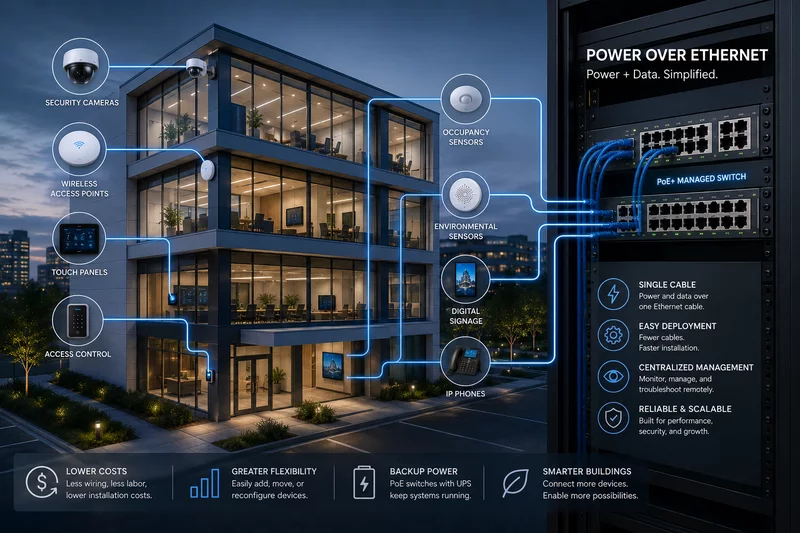
Modern buildings depend on cameras, wireless access points, touch panels, signage, sensors, phones, and access-control readers that require both power and network connectivity.
Power over Ethernet, or PoE, delivers both through a single Ethernet cable. The result can be simpler infrastructure, centralized management, improved monitoring, and easier deployment of connected building technologies.
At AVgator, PoE is part of a complete network strategy designed around today's device requirements, future expansion, serviceability, security, and reliable backup power.
What Is Power over Ethernet?
PoE allows compatible Ethernet cabling to carry network data and electrical power simultaneously. Instead of relying on a nearby outlet and local power supply, a device receives power from a PoE network switch or injector.
Why PoE Has Become So Popular
Modern properties can contain hundreds of networked devices. Providing independent electrical service to every endpoint adds cost, coordination, and maintenance. PoE centralizes much of that power distribution in the network rack.
- Fewer local electrical circuits and power supplies
- Cleaner installation and reduced ceiling congestion
- Simplified maintenance and expansion
- Centralized monitoring and backup power
- Remote restart and troubleshooting capabilities
Common Devices That Use PoE
Security cameras
IP cameras commonly receive both power and connectivity over one cable, supporting faster installation, centralized UPS backup, and remote monitoring.
Wireless access points
Access points can be mounted where radio coverage requires them instead of where an electrical outlet happens to be available.
Access control
Door controllers, readers, keypads, intercoms, and video door stations increasingly use PoE to simplify installation and centralized support.
Touch panels and scheduling displays
Room controls, smart-home interfaces, wayfinding displays, and scheduling panels benefit from a single structured connection.
Sensors and building controls
Occupancy, motion, environmental, energy, and automation devices can use PoE to deliver data, power, monitoring, and management through the building network.
Simplifying Infrastructure
A suitable PoE endpoint may need one properly designed Ethernet cable instead of separate network wiring, electrical wiring, transformers, and dedicated outlets. This can reduce installation time, material cost, coordination, ceiling congestion, and future maintenance.
The cabling still needs correct pathways, separation, support, firestopping, labeling, testing, and documentation. Simpler does not mean unengineered.
Centralized Power Management and Backup
Managed PoE switches can help operators restart devices, monitor consumption, identify faults, schedule power cycling, and see endpoint status without visiting every device.
When switches are connected to a correctly sized uninterruptible power supply, essential cameras, Wi-Fi, access control, automation controllers, and communications may continue through supported power interruptions. Centralized UPS protection can be more maintainable than batteries distributed around a building.
Planning for Power Budgets
Every switch has limits for individual ports and total available PoE power. Design calculations should consider device demand, the applicable PoE class or standard, cable length and losses, switch capacity, UPS runtime, redundancy, environmental conditions, and future expansion.
A switch can have enough network ports but still lack the PoE budget to power every connected device at full demand.
Designing Structured Cabling for Growth
Cabling often remains in place far longer than the devices connected to it. Professional planning includes spare pathways, additional switch capacity, appropriate racks and cooling, cable labeling, certified testing, and complete documentation.
This approach reduces future renovation costs and lets the building adopt new cameras, access points, sensors, controls, and other endpoints without reconstructing finished spaces.
Integrating PoE Into Smart-Building Systems
PoE creates the most value as part of an integrated ecosystem. It may support building automation, lighting controls, video surveillance, access control, AV systems, conference rooms, environmental monitoring, and the underlying network itself.
Centralized infrastructure can improve visibility, but system boundaries and responsibilities must remain clear. Critical functions should have appropriate local fallback, network resilience, and recovery procedures.
Security and Network Segmentation
As more building systems become connected, security becomes part of the infrastructure design. Managed switches, VLAN segmentation, firewalls, strong authentication, role-based permissions, encrypted remote access, firmware management, logs, and configuration backups help protect connected systems.
Building devices should not be added casually to a flat, unmanaged office network. Segmentation and access rules should follow the operational and security requirements of each system.
Common PoE Planning Mistakes
- Underestimating per-port or total switch power capacity
- Installing too little cabling or pathway capacity
- Ignoring growth, redundancy, cooling, or UPS runtime
- Using poorly organized equipment racks
- Skipping cable certification, labeling, and documentation
- Mixing unmanaged network equipment into critical systems
- Selecting devices without a long-term support plan
How AVgator Helps
AVgator designs structured network infrastructure for security, AV, lighting control, automation, wireless networking, and future building technologies. Our work can include structured cabling, network architecture, switch and PoE-budget planning, Wi-Fi, cameras, access control, conference rooms, automation networking, racks, documentation, commissioning, and ongoing support.
Whether the project is a luxury residence, corporate office, healthcare facility, educational campus, or mixed-use property, the goal is infrastructure that remains reliable, secure, serviceable, and adaptable.
Frequently Asked Questions
What is Power over Ethernet (PoE)?
PoE delivers electrical power and network data over the same Ethernet cable, allowing compatible devices to operate without separate local power supplies.
Which devices commonly use PoE?
Common examples include IP cameras, wireless access points, VoIP phones, touch panels, sensors, access readers, digital signage, intercoms, and building-automation devices.
Does PoE reduce installation costs?
Often, yes. Combining power and data can reduce local outlets, transformers, dedicated circuits, cabling, and labor, though every project still requires appropriate electrical and network engineering.
Can PoE devices continue operating during a power outage?
Devices connected to PoE switches protected by a correctly sized UPS can continue operating during supported outages, subject to the UPS runtime and total load.
How much power can PoE provide?
Available power depends on the applicable PoE standard, the switch, cabling, cable length, and the powered device. The design must account for both per-port demand and the switch's total power budget.
Is PoE suitable for residential projects?
Yes. Luxury residences commonly use PoE for wireless access points, surveillance cameras, touch panels, intercoms, door stations, and other connected systems.
Does every Ethernet cable support PoE?
Support depends on cable category and quality, conductor construction, installation practices, distance, certification, connected equipment, and the required power level.
Why should PoE infrastructure be planned early?
Early planning coordinates network rooms, pathways, rack space, cooling, switch capacity, UPS systems, cabling, and expansion before construction limits the available options.
Can PoE support smart-building automation?
Yes. Many controls, sensors, access systems, security devices, and environmental-monitoring products use PoE as part of an integrated building network.
Why choose AVgator for PoE system design?
AVgator coordinates PoE with structured cabling, switch power budgets, networks, AV, security, automation, backup power, documentation, and long-term scalability.
A Foundation for Connected Buildings
PoE is more than a convenient way to power devices. When paired with careful network, power, security, and cabling design, it becomes a scalable foundation for modern building technology.
Explore AVgator's structured-cabling and building-automation services, or schedule a project consultation.