Modern Access Control for Growing Offices
Credentials, visitor workflows, door hardware, integrations, and management considerations for flexible workplaces.
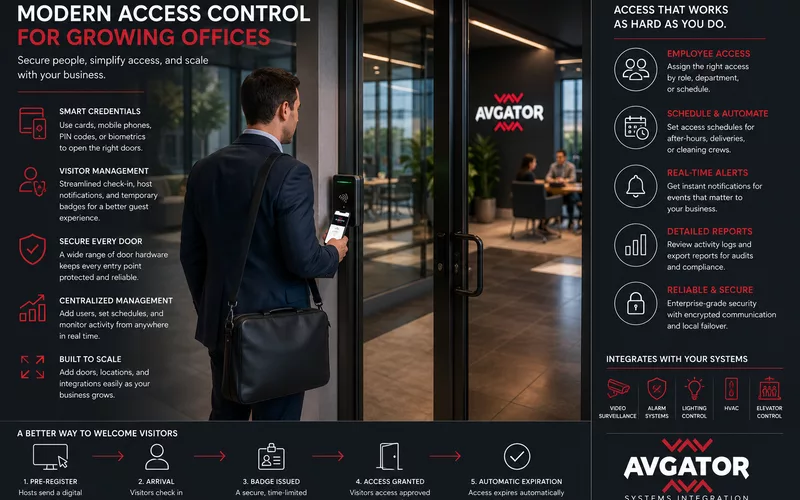
As teams, locations, schedules, and security requirements grow, traditional keys become difficult to manage.
Modern access control coordinates credentials, door hardware, visitors, audit trails, networks, video, and building workflows. AVgator designs systems around office operations so security can scale without becoming burdensome.
Why Offices Are Moving Beyond Keys
- Lost or stolen keys
- Expensive rekeying
- Limited audit trails
- Slow employee offboarding
- No remote administration
- No schedule-based permissions
Start With Office Workflows
Employee count, hybrid schedules, restricted areas, visitor escort policies, after-hours operations, deliveries, and multiple locations determine the access strategy before hardware is selected.
Choosing the Right Credentials
RFID cards and key fobs
Familiar, inexpensive, and easy to issue or replace.
Mobile credentials
Allow contactless entry, remote activation, and fewer physical items to manage.
PINs and biometrics
PINs can support shared or backup workflows; biometrics can add verification where policy and privacy requirements justify it.
Visitor Management Matters
- Digital preregistration
- Host notifications
- Temporary or time-limited credentials
- Visitor badges
- Restricted door access
- Automatic expiration and audit records
Door Hardware Is as Important as Software
Door construction, fire and life-safety requirements, egress, accessibility, electric strikes, magnetic locks, electrified panic hardware, position sensors, request-to-exit devices, and power transfer all require early coordination with the architect, hardware consultant, electrician, and authority having jurisdiction.
Plan for Future Growth
The platform and infrastructure should accommodate future doors, employees, locations, parking gates, warehouses, server rooms, executive suites, and changing schedules without wholesale replacement.
Integrate With Other Building Systems
Access events can coordinate surveillance, alarms, visitor systems, lighting, HVAC, elevators, and workplace platforms. The first authorized arrival might disarm approved zones, enable occupied lighting and HVAC schedules, and prepare shared rooms.
Remote Administration and Audit Trails
Authorized administrators can add and disable credentials, change schedules, unlock doors, review activity, receive alerts, and generate reports. Role-based permissions and logging are essential, especially across multiple locations.
Infrastructure, Resilience, and Security
- Structured cabling and managed networks
- PoE or listed power supplies where appropriate
- UPS and battery backup
- Secure controller locations
- Encrypted communications and strong authentication
- Configuration backups and documentation
Common Planning Mistakes
- Treating access control as standalone
- Ignoring future expansion
- Incompatible door hardware
- No visitor strategy
- Poor documentation or service access
- Inadequate backup power
- No video-surveillance integration
- Unclear offboarding responsibility
Frequently Asked Questions
What is modern access control?
Electronic credentials, intelligent door hardware, and centralized management used to control and document access.
What credentials are available?
RFID cards, fobs, mobile credentials, PINs, and biometric methods are common options.
Can it integrate with cameras?
Yes. Door events can be associated with recorded or live video for faster review.
What happens when an employee leaves?
Their credential can be disabled immediately without rekeying other users.
Can it support hybrid work?
Yes. Permissions and schedules can reflect rotating teams, temporary access, and flexible hours.
Is PoE used for access control?
Many readers, intercoms, and controllers use PoE, subject to the listed system design and life-safety requirements.
Can visitors receive temporary access?
Yes. Visitor systems can issue limited credentials, notify hosts, print badges, and expire access automatically.
When should access control be planned?
During architectural, door-hardware, electrical, network, and life-safety design.
Can an existing office be upgraded?
Yes, following a survey of doors, hardware, cabling, power, networks, code requirements, and operational workflows.
Why choose AVgator?
AVgator coordinates credentials, doors, visitors, networks, video, automation, commissioning, documentation, and support as one workplace strategy.
Plan the System as Infrastructure
Successful projects coordinate technology with architecture, electrical work, networks, construction, commissioning, documentation, and long-term service from the beginning.
Explore AVgator's security and access-control services or schedule a project consultation.