Security Camera Placement Without Compromising Design
How field of view, lighting, mounting height, and architecture determine effective, discreet surveillance.
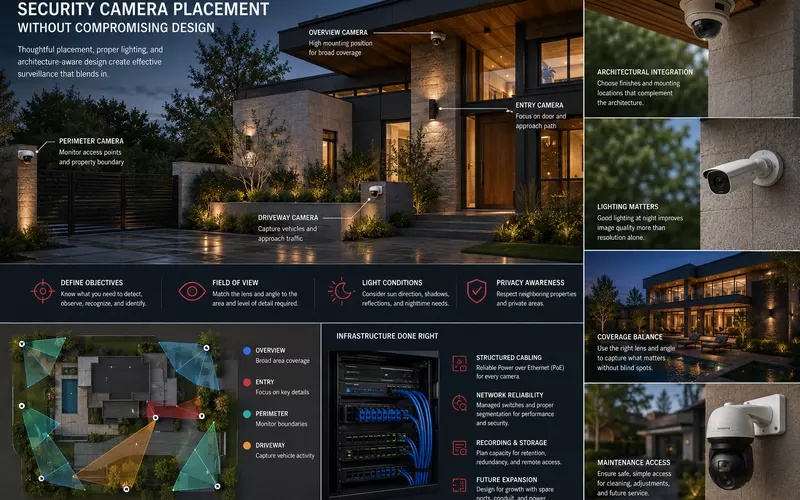
Installing more cameras does not automatically create better security. Usable surveillance depends on thoughtful placement, appropriate image detail, lighting, and infrastructure—not camera quantity alone.
At the same time, cameras should respect the property’s architecture. Early coordination makes it possible to conceal wiring, select appropriate mounting surfaces, preserve clean sightlines, and maintain access for future service.
Security Starts With Objectives
Whenever possible, camera design should begin during the architectural phase with the architect, builder, landscape and lighting designers, electrician, security consultant, and low-voltage integrator.
Before choosing hardware, define whether each view needs to identify people, detect activity, monitor property, document deliveries, observe vehicles, protect outdoor spaces, secure entrances, or support remote awareness. The objective determines the lens, location, angle, resolution, and recording strategy.
Detection, Observation, Recognition, and Identification
Confirm that something is present, such as movement near a property boundary.
Understand general activity, such as a person approaching an entrance.
Distinguish a familiar person, vehicle, or recurring subject.
Capture sufficient detail to identify an unknown subject for investigation.
Different locations need different levels. Treating every camera as a broad overview often produces footage that shows an event but cannot explain who or what was involved.
Field of View and Coverage
A wider field captures more area but spreads available pixels across the scene, reducing detail. A narrower field covers less area while preserving more information about the important subject. One extremely wide camera rarely replaces several purposefully positioned cameras.
Prioritize property entries, approaches, gates, walkways, parking, loading, outdoor gathering areas, and sensitive equipment. The goal is useful evidence, not simply colored coverage on a plan.
Placement by Location
Front entries
Consider the visitor approach, package placement, doorbell interaction, porch structure, landscaping, and light. A dedicated doorbell camera paired with an overview camera often performs better than either alone.
Driveways and vehicle routes
Vehicle direction, plate visibility, headlight glare, shadows, trees, gate geometry, and garage placement all affect the view. Identification usually requires a different angle than general driveway coverage.
Side and rear yards
Side yards may expose gates, utilities, HVAC, windows, and service doors. Rear coverage may include pools, kitchens, patios, fire pits, play areas, and boundaries without making private outdoor living feel over-surveilled.
Commercial entrances
Customer doors, employee entries, reception areas, deliveries, exits, and loading docks have different traffic patterns and may require distinct camera types and recording policies.
Mounting Height Is a Tradeoff
Higher positions increase broad coverage and tamper resistance; lower positions usually capture better faces. The correct height balances objective, distance, angle, service access, appearance, and risk. Mounting a camera extremely high may create an impressive overview but poor identification.
Lighting and Night Performance
Direct sun, shadows, porch fixtures, landscape lighting, glass reflections, streetlights, and vehicle headlights can affect footage more than headline resolution. Sunrise, sunset, and bright backgrounds may obscure faces unless the placement accounts for them.
Infrared helps in darkness, but coordinated exterior lighting generally improves color, facial recognition, vehicle detail, and overall safety. Lighting and surveillance should be designed together.
Architectural and Environmental Integration
Compact form factors, finish-matched housings, concealed cable, soffit integration, overhang mounting, and alignment with structural features allow cameras to remain effective without dominating the facade.
Exterior selections must also account for rain, wind, heat, UV, humidity, dust, snow, and—in applicable locations—coastal conditions. Sheltered but unobstructed mounts can reduce maintenance and extend service life.
Camera Type and Lens Selection
Dome, bullet, turret, PTZ, fisheye, and multi-sensor cameras serve different needs. The right type follows coverage and service requirements rather than appearance alone.
Lens selection determines composition and usable detail. Subject distance, desired field, mounting point, lighting, and identification requirement should be evaluated together. Correct lenses can produce better results with fewer cameras.
Network and Recording Infrastructure
Professional systems typically use structured Ethernet, managed switching, PoE, UPS backup, surveillance VLANs, and secure remote access. Network reliability and cybersecurity are as important as the cameras.
Storage planning must account for camera count, resolution, frame rate, retention, continuous or event recording, analytics, redundancy, and remote retrieval. Calculate these needs before equipment is purchased.
Privacy, Maintenance, and Future Expansion
Views should avoid neighboring properties, private interiors, sensitive workspaces, and areas with reasonable privacy expectations. Security goals do not eliminate the responsibility to limit unnecessary recording.
Every camera eventually needs cleaning, adjustment, inspection, firmware work, or replacement. Mounts must remain safely accessible. Spare PoE capacity, rack space, recording capacity, network ports, and conduit make later expansion far easier.
Documentation should record camera schedules, models, lenses, mounting heights, coverage drawings, topology, recording settings, equipment, and user procedures. Commissioning should verify focus, daytime and night images, recording, analytics, notifications, remote access, and actual coverage.
Common Camera-Placement Mistakes
- Mounting cameras too high
- Using excessively wide views
- Ignoring sun and nighttime light
- Leaving surface wiring visible
- Creating blind spots
- Weak network planning
- Unsafe maintenance access
- Recording unnecessary areas
- Missing documentation
- No expansion capacity
A professional plan coordinates security goals, architecture, light, networking, storage, privacy, testing, and long-term support into one system.
Frequently Asked Questions
Where should security cameras be placed?
Cameras commonly monitor entrances, driveways, walkways, gates, outdoor living spaces, parking, and other meaningful access points while avoiding unnecessary overlap.
Is one wide-angle camera better than multiple cameras?
Usually not. Several properly positioned cameras provide more useful identification detail and fewer blind spots than one extremely wide view.
How high should outdoor cameras be mounted?
Height depends on the objective. Professional design balances facial detail, tamper resistance, angle, architecture, and safe service access.
Does lighting affect camera quality?
Yes. Lighting often affects usable image quality more than resolution alone, especially around faces, vehicles, glare, and nighttime color.
Should cameras be visible?
Visible cameras may deter activity, but placement, size, color, and mounting should still respect the architecture.
Can cameras see in complete darkness?
Many use infrared illumination, but coordinated exterior lighting generally improves color, facial detail, and overall nighttime performance.
What is Power over Ethernet?
PoE carries power and network data over one Ethernet cable, simplifying camera installation and centralizing backup power.
Should cameras record continuously?
That depends on risk, operations, storage, and policy. Some projects use continuous recording while others combine events and analytics.
How long should footage be stored?
Retention depends on operational goals, applicable requirements, recording quality, camera count, and available storage.
Should camera wiring be installed during construction?
Yes. Prewiring allows concealed routes, cleaner mounting, reliable PoE connectivity, and easier expansion.
Can cameras integrate with smart-home systems?
Yes. Professional surveillance can coordinate with lighting, access control, alarms, intercoms, automation, and remote management.
How often should cameras be maintained?
Inspect them regularly to clean lenses, confirm focus and views, review recordings, update firmware, and verify network health.
Security That Belongs in the Architecture
Effective surveillance captures meaningful detail without making the property feel like a facility. AVgator designs camera systems for Charlotte residences, offices, campuses, retail spaces, and outdoor environments.
Schedule a surveillance-design consultation to coordinate coverage, cabling, lighting, networking, recording, and architectural integration.