Top 10 Smart Home Features Every Luxury Home Should Have
Discover the 10 smart home features that define today's luxury homes, from intelligent lighting and motorized shades to enterprise networking and whole-home automation.
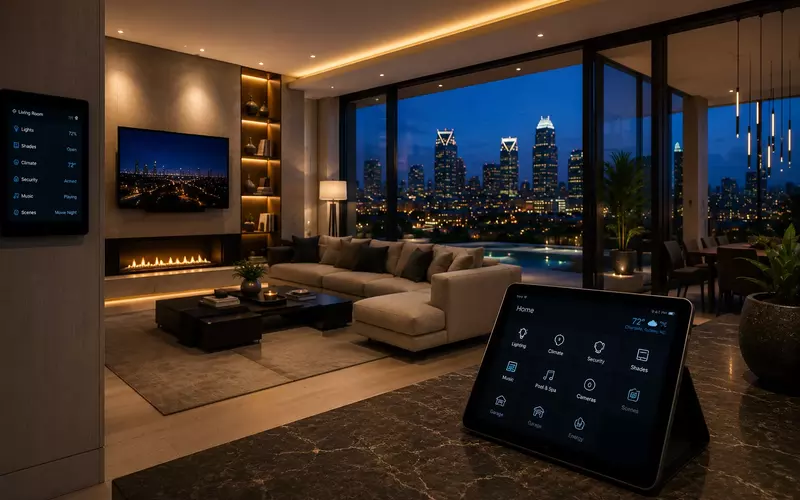
Luxury homes today are defined by more than premium finishes and impressive architecture. The most exceptional residences seamlessly combine technology, comfort, security, and efficiency, creating spaces that adapt to the people who live in them.
A professionally integrated smart home is not simply a collection of connected gadgets. It is a thoughtfully engineered system where lighting, climate, entertainment, networking, security, and automation work together as a unified experience.
Whether you're building a custom home, renovating an existing property, or working with an architect or interior designer, understanding the technologies available today can help you make informed decisions that add long-term value.
The best results come from planning them as parts of one coordinated system.
01 Intelligent Lighting Control
Lighting is often the first system homeowners choose to automate, and for good reason.
A professionally designed lighting-control system goes far beyond replacing wall switches with smartphone apps. It creates an environment that adapts throughout the day, improves comfort, reduces energy consumption, and enhances the overall architectural experience.
Common capabilities include:
- Personalized lighting scenes
- One-touch Good Morning and Good Night modes
- Vacation schedules
- Occupancy-based lighting
- Outdoor landscape lighting
- Entertainment-system integration
- Automatic dimming based on daylight
Professional platforms such as Lutron, KNX, and DALI offer significantly greater flexibility and reliability than consumer-grade smart bulbs.
02 Motorized Shades
Motorized window treatments have become one of the most requested upgrades in luxury homes. Automated shades can respond to sunrise and sunset, indoor temperature, solar heat gain, occupancy, privacy schedules, and lighting scenes.
Benefits include improved comfort, reduced HVAC load, UV protection for furniture and artwork, enhanced privacy, and quiet, elegant operation.
Because wiring requirements vary, shade planning is ideally completed during the design phase of a new build. Learn more about the practical benefits of motorized shading and how it can coordinate with lighting and whole-home control.
03 Enterprise-Grade Home Networking
Every smart home depends on a reliable network. Unfortunately, networking is also one of the most overlooked parts of residential construction.
A luxury home should include professionally designed network infrastructure such as:
- Structured cabling
- Enterprise Wi-Fi
- Ceiling-mounted access points
- Managed switches
- Fiber backbone where appropriate
- Central equipment rack
- UPS battery backup
- Remote monitoring
A robust network improves the performance of every connected system, from streaming media to security cameras and automation controllers.
04 Whole-Home Audio
Distributed audio allows music and other media to follow you throughout the home. Typical listening areas include kitchens, living rooms, bedrooms, patios, pools, gyms, garages, and outdoor entertaining spaces.
Professional installations use discreet architectural speakers, centralized amplification, and intuitive control through wall keypads, touch panels, or mobile devices.
05 Home Theater and Media Rooms
For many homeowners, entertainment is a central part of the smart home experience.
A dedicated home theater or media room may include large-format displays or projectors, Dolby Atmos surround sound, acoustic treatment, automated lighting, motorized shades, equipment racks, and climate integration.
By combining these systems, homeowners can start an entire movie experience with a single button press.
06 Integrated Climate Control
Heating and cooling systems can participate in the home's broader automation strategy. Examples include automatic setback schedules, occupancy-based temperature control, vacation mode, humidity management, multi-zone temperature control, and integration with shading systems.
Rather than operating independently, climate systems become part of a coordinated living environment.
07 Smart Security and Access Control
Security systems have evolved well beyond traditional alarms. Modern luxury homes often integrate:
- Video doorbells
- IP surveillance cameras
- Smart locks
- Gate automation
- Occupancy simulation
- Motion detection
- Mobile notifications
- Remote access
When combined with lighting and automation, the home can respond intelligently to both expected and unexpected events.
08 Unified Home Control
One of the defining characteristics of a professionally integrated smart home is simplicity.
Instead of using separate apps for lighting, music, HVAC, security, and shades, homeowners can control every major system through a consistent interface. Depending on project requirements, this may include wall-mounted touch panels, mobile applications, handheld remotes, voice assistants, custom dashboards, and scene buttons.
09 Remote Monitoring and Preventive Maintenance
Many professional automation systems support secure remote diagnostics. With homeowner approval, authorized service teams can monitor system health, detect equipment failures, review network status, perform software updates, resolve configuration issues, and reduce unnecessary service visits.
This proactive approach helps improve reliability while minimizing downtime.
10 Future-Proof Infrastructure
Technology changes quickly, but homes are expected to last for decades. The best investment is often infrastructure rather than individual devices.
A future-ready home typically includes:
- Structured wiring
- Equipment space for expansion
- Spare conduit pathways
- High-capacity networking
- Modular automation platforms
- Documented cable labeling
- Comprehensive system documentation
Planning for future upgrades during construction is usually far less expensive than making structural changes after the home is complete. A thoughtful structured-cabling plan preserves options long after the first system is installed.
Why Planning Matters More Than Products
One of the most common misconceptions about smart homes is that choosing the “right” products is the most important decision. In reality, successful projects begin with careful planning.
Professional integration considers architectural drawings, interior design, electrical layouts, lighting design, AV requirements, network topology, future expansion, service accessibility, and the construction schedule.
Frequently Asked Questions
Do luxury homes need a central automation system?
Not every home requires a single centralized controller, but professionally integrated systems generally provide a more consistent and reliable user experience than independent smart devices.
Can these smart home features be added later?
Many can, but installing infrastructure during construction typically reduces labor costs and increases design flexibility.
Is wireless technology sufficient for a luxury smart home?
Wireless devices continue to improve, but professionally installed luxury homes often combine wired infrastructure with wireless technologies to maximize reliability and performance.
Which automation platform is best?
There is no universal answer. The right platform depends on the home's size, project goals, required integrations, long-term maintenance strategy, and budget.
Planning a Luxury Smart Home?
Luxury smart homes are no longer defined by novelty. They are defined by thoughtful engineering. Lighting, networking, entertainment, climate, shading, and security should work together as a cohesive ecosystem that enhances everyday living while remaining easy to operate.
Whether you're designing a new residence or modernizing an existing property, investing in scalable infrastructure and professional system planning helps ensure your home remains adaptable for years to come.
AVgator works with homeowners, architects, builders, and interior designers throughout the Charlotte region to develop smart home solutions tailored to each property. From low-voltage infrastructure and enterprise networking to lighting control, distributed audio, home theaters, and whole-home automation, our focus is on creating systems that are reliable, scalable, and designed for long-term performance.
Schedule a project consultation with AVgator to discuss your property's architectural, technical, and lifestyle requirements.