How Much Does a Smart Home Cost in Charlotte?
Budget ranges and planning considerations for Charlotte renovations, custom homes, and large residences.
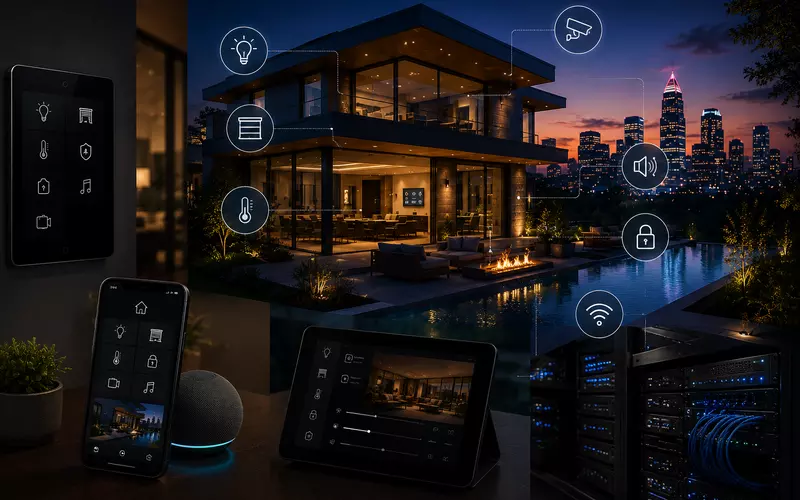
One of the first questions homeowners ask is, “How much does a smart home cost?” The honest answer depends less on square footage than on the systems being integrated, the level of customization, and when the technology team becomes involved.
A smart home might combine selected lighting and climate controls, or unite lighting, shading, HVAC, security, audio, video, networking, access, energy management, and outdoor entertainment through one interface. For Charlotte homeowners building or renovating, the strongest investment begins with planning rather than products.
Smart-Home Cost Is About Scope, Not Square Footage
Home size affects wiring, network coverage, and equipment quantities, but two equally sized homes can carry dramatically different technology budgets. A carefully designed 3,500-square-foot home may require more integration than a minimally automated 8,000-square-foot residence.
Major cost drivers include room count, lighting, shades, audio and video, networking, security, access control, outdoor systems, HVAC zoning, interface requirements, equipment locations, and architectural complexity.
Start With Infrastructure
Professional smart homes are built on infrastructure rather than isolated devices. A dependable foundation commonly includes structured Ethernet cabling, equipment racks, enterprise-grade networking, wired Wi-Fi access points, electrical coordination, low-voltage wiring, dedicated AV pathways, and conduit for future expansion.
Although most of this work disappears behind walls, it determines how reliable, serviceable, and adaptable the home will remain.
Typical Investment Levels
Every project is unique, but early planning often places residential projects into three broad scope categories. These are functional levels, not fixed-price packages.
Entry-level smart home
Often appropriate for condominiums, townhomes, smaller residences, and focused renovations.
- Reliable Wi-Fi
- Smart thermostat and locks
- Video doorbell or basic security
- Selected lighting automation
- Mobile-app control
Mid-level integrated home
Common for custom homes, major renovations, and families seeking a unified ecosystem.
- Professional whole-home networking
- Lighting scenes and selected shades
- Multi-room audio and outdoor entertainment
- Cameras, garage, and HVAC integration
- Centralized control
Luxury smart home
Designed as a complete system for large custom residences and demanding properties.
- Architectural lighting and whole-home shading
- Distributed AV and dedicated theaters
- Enterprise networking and surveillance
- Access, outdoor, pool, energy, and backup-power integration
- Remote management and building automation
Charlotte Construction Considerations
Charlotte custom homes and renovations often include open floor plans, extensive outdoor living, covered patios, pools, detached garages, guest suites, offices, and dedicated media rooms. These features increase the importance of whole-property Wi-Fi, outdoor audio, landscape lighting, shading, and coordinated security.
Planning early lets these systems share a coherent infrastructure before construction closes off efficient pathways.
New Construction vs. Renovation
New construction
Building during construction provides the greatest flexibility for concealed wiring, equipment locations, electrical infrastructure, lighting panels, shade power, conduit, and rack space. Early design usually reduces labor and avoids opening finished walls later.
Renovation projects
Existing homes can absolutely be upgraded, but may require selective rewiring, wireless or battery-powered devices, creative cable routing, surface-mounted equipment, and additional labor. A professional site survey establishes what can be reused and where new infrastructure will create the most value.
Systems That Shape the Budget
Lighting control and motorized shades
Lighting control may range from selected rooms to whole-home dimming, architectural keypads, sensors, schedules, vacation modes, and landscape lighting. Motorized shades are influenced by window count and dimensions, fabric, pockets, wiring, and integration; large glass walls and theaters often benefit most.
Home networking
A professional residential network may include wired access points, managed switches, structured cabling, fiber, rack equipment, UPS backup, and secure remote support. Networking should be treated as permanent infrastructure because nearly every connected system depends on it.
Audio, video, and entertainment
Media rooms, home theaters, whole-home audio, outdoor entertainment, distributed television, and architectural speakers have very different performance and design requirements. The right scope follows how the family actually watches, listens, and entertains.
Security, surveillance, and outdoor living
Camera quantity, recording, locks, access control, intrusion sensors, backup power, and monitoring all shape security-system cost. Outdoors, automation may extend to lighting, speakers, televisions, pools, irrigation, heating, screens, and exterior cameras.
Hidden Costs to Consider
Hardware is only one part of a professional project. A complete budget should account for design, engineering, programming, rack assembly, network configuration, commissioning, documentation, training, maintenance, and future software updates.
Professional integration is the work that turns individual products into one dependable, documented, and supportable system.
Future Expansion and Long-Term Value
A phased approach can work extremely well when the complete architecture is planned first. During construction, extra conduit, network cabling, rack space, spare circuits, shade wiring, wall boxes, and panel capacity cost far less than reopening completed spaces.
The return is not purely financial. Homeowners often value comfort, simpler routines, security, entertaining, energy awareness, better remote work, future readiness, and stronger perceived property value. Thoughtful design usually creates more lasting value than premium hardware alone.
Choose the Platform—and the Team—Carefully
Technologies such as KNX, Control4, Crestron, Lutron, DALI, BACnet, and Modbus serve different roles. Platform selection should follow present requirements, expansion plans, service expectations, and the property's complete system architecture.
The best results come from early collaboration among homeowners, architects, interior designers, builders, electricians, HVAC contractors, landscape designers, and low-voltage integrators. Coordination reduces change orders and installation compromises.
Frequently Asked Questions
How much does a smart home cost in Charlotte?
There is no single price. Cost depends on home size, integrated systems, construction stage, customization, and the desired level of automation. Professional projects should be planned around goals rather than a predefined package.
Is it less expensive to automate a new home?
Generally, yes. New construction allows wiring, pathways, equipment locations, and electrical infrastructure to be coordinated before walls are finished, reducing labor and preserving flexibility.
Can an existing home be upgraded?
Yes. Many Charlotte homes can add professional networking, lighting control, motorized shades, security, entertainment, and automation through a mix of wired and wireless solutions.
What usually represents the largest part of the budget?
Infrastructure, lighting control, motorized shades, networking, distributed audio, equipment, and programming are often major portions of a comprehensive project.
Should I automate everything at once?
Not necessarily. Many homeowners establish the networking and infrastructure first, then expand lighting, security, entertainment, and shading in planned phases.
Does home size determine cost?
Only partially. Homes of similar size can have very different budgets depending on system count, finish level, performance expectations, and customization.
Are professional systems more expensive than consumer devices?
They generally require more initial investment, but often provide stronger reliability, integration, scalability, documentation, commissioning, and long-term support.
Should networking be included in the automation budget?
Yes. Reliable networking supports nearly every connected system, including lighting, security, AV, HVAC, and remote access.
Can outdoor spaces be included?
Yes. Landscape lighting, speakers, televisions, pools, patios, cameras, and motorized screens can be coordinated with the primary automation platform.
Is motorized shading worth including?
It can add meaningful comfort, privacy, and daylight control, especially in homes with large windows, strong afternoon sun, extensive glass, or dedicated theaters.
How early should planning begin?
Ideally during architectural design, while electrical, HVAC, networking, lighting, shading, and automation can still be coordinated efficiently.
Can smart-home systems increase property value?
Market results vary, but professionally integrated networking, security, lighting, and automation can strengthen a luxury property's appeal and future readiness.
Should I budget for future upgrades?
Yes. Extra conduit, structured cabling, rack space, electrical capacity, and expansion pathways installed during construction can substantially reduce future upgrade costs.
A Better Question for Your Smart-Home Budget
Instead of asking only, “How much does a smart home cost?” ask, “Which systems will provide the greatest value for the way we live?” Reliable infrastructure, lighting, shades, entertainment, security, climate, and automation can then be prioritized around real goals.
AVgator helps homeowners, architects, builders, and designers throughout Charlotte develop scalable smart-home strategies aligned with project goals, budgets, and long-term expectations. Schedule a project consultation to start defining the right scope.